
The Evidence In Practice research project at the Yale School of Management was conducted in order to better understand the conditions under which rigorous evidence can be effectively integrated into public policies and NGO practices in the field of international development. RubyStudio collaborated to create the outputs of the research: eight paired case studies from four countries: Ghana, South Africa, Mexico, and India.
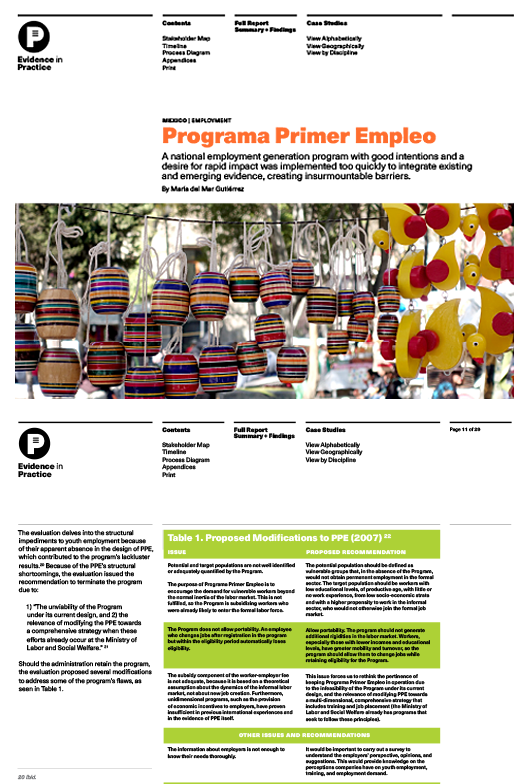
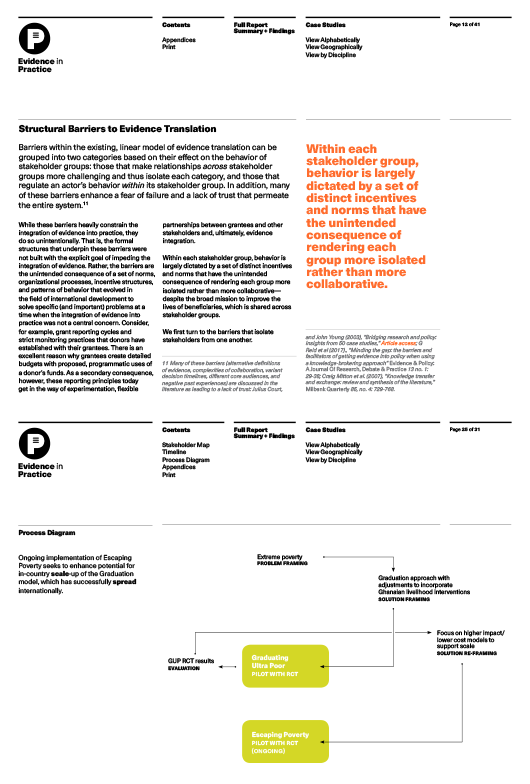
The research project collected date from hundreds of of expert interviews with individuals who have spent a significant portion of their professional lives attempting, researching, or promoting the integration of evidence into development practice, including academics, government officials, foundation program officers, NGO practitioners, and think-tank directors in conjunction with interviews of prototypical representatives of each of the stakeholder groups, or individuals who could clearly describe the typical experience of enacting a particular stakeholder role. Eight cases were studied of development programs or interventions where rigorous evidence was integrated with varying degrees of effectiveness.
This immense amount of information needed to be communicated clearly, easily distributed, and in a useful medium for all potential stakeholders—researchers, finaiciers, policy makers, implementers, and influencers—who may or may not have access to technology most Americans rarely have to consider like consistent electricity, cell service, and internet access.
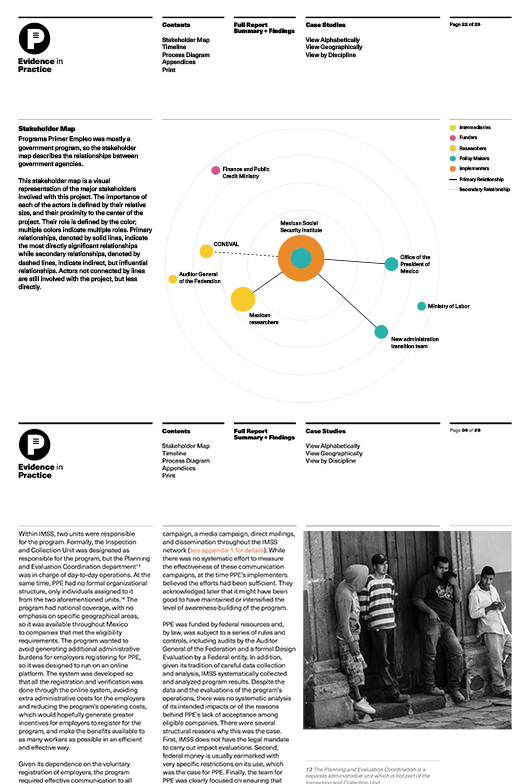
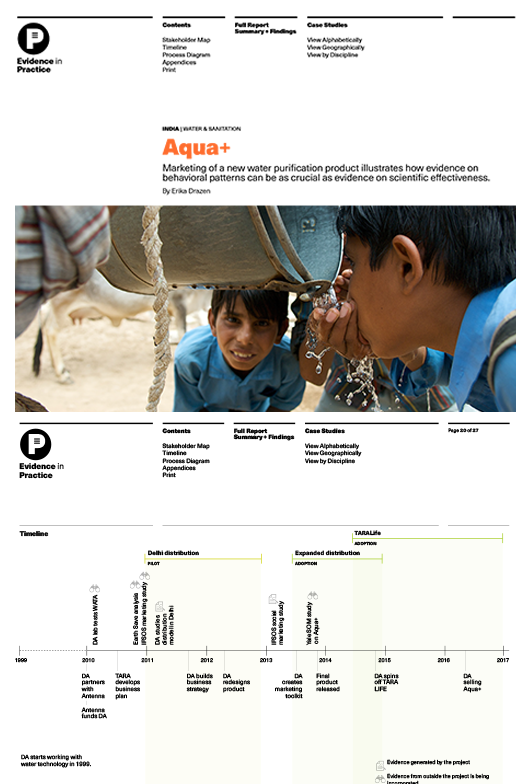
We began by solving the most fundamental challenge: how do you deliver complex research to an audience that may have no reliable internet access? We chose to build the deliverables as a series of lightweight, downloadable PDFs — optimized for printing, easy to share across low-bandwidth environments, and accessible to every stakeholder in the chain regardless of their technology infrastructure.
From there, we developed a comprehensive visual editorial system designed to make dense, data-heavy information immediately navigable. This included a consistent page architecture across all eight case studies, allowing readers to locate information quickly without having to relearn the structure with each document. We integrated a system of infographics that translated complex comparative data into clear visual narratives — making it immediately apparent where evidence integration succeeded, where it fell short, and what factors drove the difference.
Betsy Vardell shepherded the visual system design, editorial structure, information architecture, and production oversight from concept through final delivery.
The result is a suite of research communications tools used by researchers, policy makers, NGO practitioners, and financiers across four countries — materials that make rigorous academic evidence genuinely accessible to the people who need it most.